Guillotine: The Timbers of Justice by Robert Frederick Opie
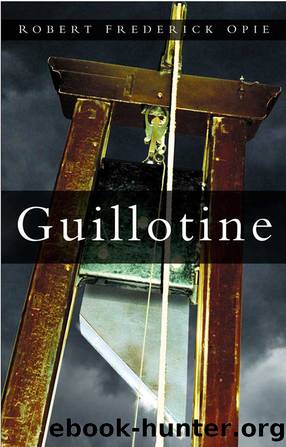
Author:Robert Frederick Opie
Language: eng
Format: epub
ISBN: 9780752496054
Publisher: The History Press
Published: 2013-03-26T16:00:00+00:00
When the guillotine first appeared in the late eighteenth century, it was state-of-the-art equipment and its very efficiency set it apart.
It may have been extremely bloody when put to use, but it was considered quick, efficient and relatively painless. It was publicly and politically acceptable because of the powerful concept of equality, both in life and also in death for those who transgressed the rule of law. The search for a method of execution that accords with society’s perceptions of decency has continued wherever capital punishment is practised. The debate on the means, the efficacy and the justification for capital punishment will doubtless continue as long as the practice of judicial execution holds sway, but in revolutionary France the guillotine was believed to be the perfect means.
It may have been the ‘perfect’ machine, but even in the guillotine’s early days some people felt it was not fast enough. During the Terror there were so many executions to be carried out that the standard guillotine could not keep pace with the numbers. A few inventive but warped minds suggested the construction of a new machine, a nine-bladed monster. There were even rumours that such a device was already under construction. M. Guillot, who was blessed with a most appropriate name, was linked with the invention and construction of the new device. Thankfully the nightmarish machine never materialised and soon afterwards the inventive Guillot was arrested for the crime of forgery. Found guilty, he was quite efficiently guillotined on the existing standard model.
Meanwhile the military commissioners at Bordeaux, under the supervision and leadership of one M. Lacombe, had constructed or at least planned a four-bladed machine. Fortune smiled on the citizens of Bordeaux, since once again this product of over-ambitious minds bent on maximum destruction was never recorded as seeing active service. If ever such a device was constructed, then it no longer exists.
The first guillotine differed somewhat from its latter-day counterparts. It was undoubtedly a taller machine, standing almost 18ft high, and was of much heavier construction. By the early 1800s, some twenty or so years after its debut, it had permanently adopted the design features still familiar to us today. Over the following one hundred years only minor alterations were made to its basic structure. Standing almost 15ft high (4.5m), the two uprights with copper-lined grooves were spaced 141⁄2in (37cm) apart. The oblique razor-edged blade weighed 16lb (7kg) and was attached to a heavy iron weight (the mouton) by three large steel bolts each weighing 2lb (1kg). Affixed to the tongues on the outer edge of the mouton were four small wheels, two on each side located one above the other, to increase the speed of the drop. The mouton had a mass of some 70lb (30kg) and was hauled aloft by means of a rope over a single large pulley attached to the top crossbar. The bascule, a hinged and tilting plank to which the victim’s body was securely strapped, could be swiftly tipped from the perpendicular to the horizontal plane and slid forward on a roller towards the uprights.
Download
This site does not store any files on its server. We only index and link to content provided by other sites. Please contact the content providers to delete copyright contents if any and email us, we'll remove relevant links or contents immediately.
| Automotive | Engineering |
| Transportation |
Whiskies Galore by Ian Buxton(42079)
Introduction to Aircraft Design (Cambridge Aerospace Series) by John P. Fielding(33175)
Small Unmanned Fixed-wing Aircraft Design by Andrew J. Keane Andras Sobester James P. Scanlan & András Sóbester & James P. Scanlan(32835)
Craft Beer for the Homebrewer by Michael Agnew(18287)
Turbulence by E. J. Noyes(8113)
The Complete Stick Figure Physics Tutorials by Allen Sarah(7424)
The Thirst by Nesbo Jo(7002)
Kaplan MCAT General Chemistry Review by Kaplan(6989)
Bad Blood by John Carreyrou(6670)
Modelling of Convective Heat and Mass Transfer in Rotating Flows by Igor V. Shevchuk(6495)
Weapons of Math Destruction by Cathy O'Neil(6362)
Learning SQL by Alan Beaulieu(6345)
Man-made Catastrophes and Risk Information Concealment by Dmitry Chernov & Didier Sornette(6138)
Digital Minimalism by Cal Newport;(5835)
Life 3.0: Being Human in the Age of Artificial Intelligence by Tegmark Max(5618)
iGen by Jean M. Twenge(5454)
Secrets of Antigravity Propulsion: Tesla, UFOs, and Classified Aerospace Technology by Ph.D. Paul A. Laviolette(5412)
Design of Trajectory Optimization Approach for Space Maneuver Vehicle Skip Entry Problems by Runqi Chai & Al Savvaris & Antonios Tsourdos & Senchun Chai(5140)
Pale Blue Dot by Carl Sagan(5080)
